

Part of our The Galápagos guide →
In the water at a glance
- Warm season
- December to May, 23–27°C (73–80°F)
- Cool garúa season
- June to November, 18–22°C (64–72°F)
- Warm-season kit
- Shorty wetsuit or rash guard
- Cool-season kit
- 3mm to 5mm full wetsuit
- Provided aboard
- Mask, snorkel, fins and wetsuit loan on most ships
- Frequency
- Usually one or two snorkel outings a day
What Will You Actually Swim With?
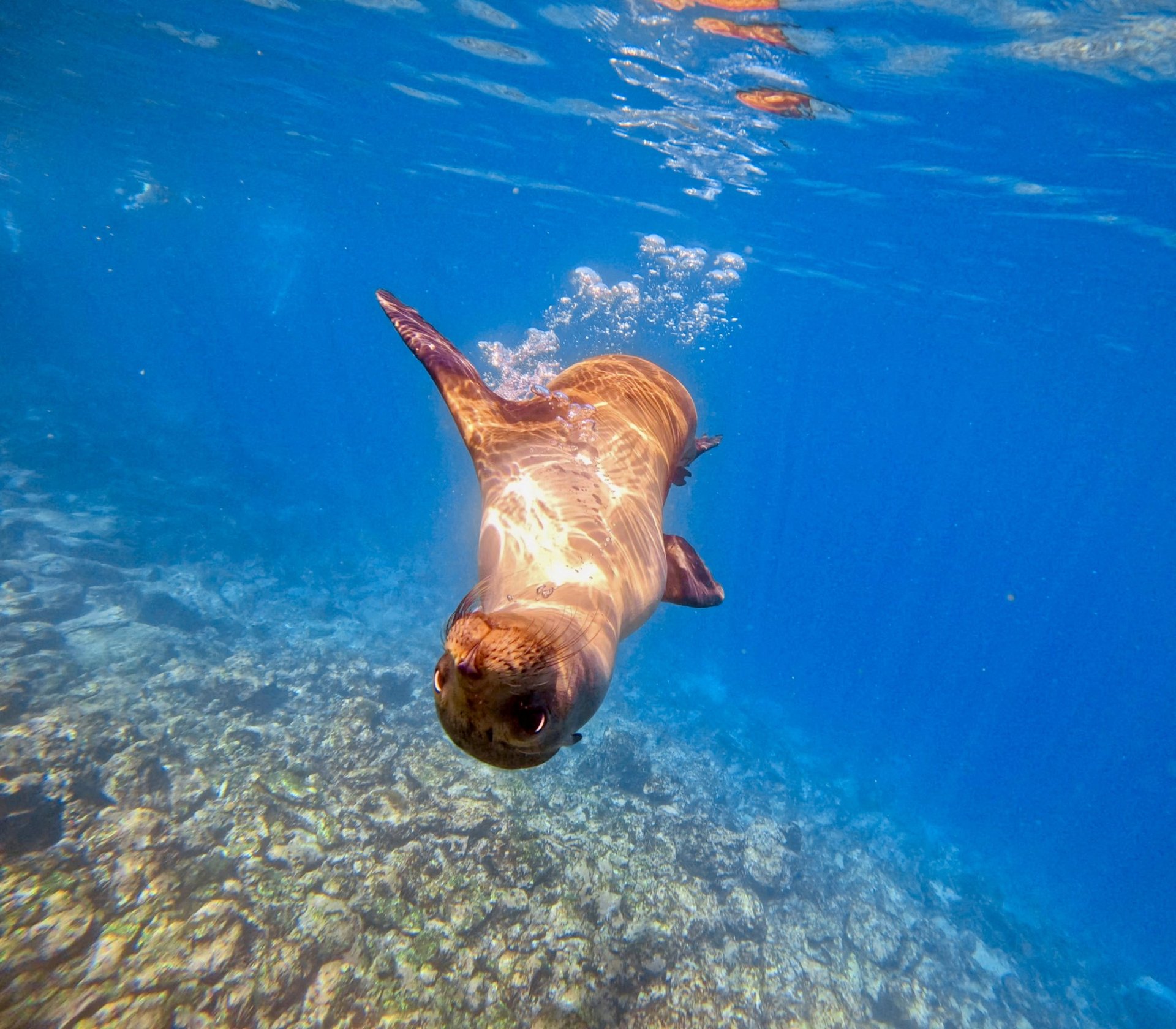
Galápagos sea lions, which routinely come to you, Pacific green sea turtles, white-tip reef sharks resting under ledges, eagle rays, marine iguanas grazing on algae, and shoals of tropical fish. In the west and at cooler sites, Galápagos penguins hunt past at speed.
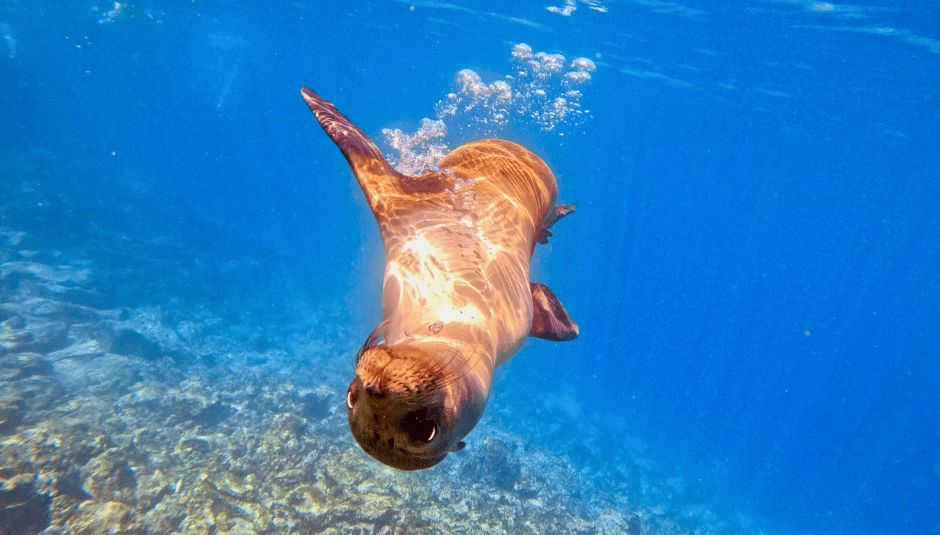
Nothing is baited or fed. Encounters happen because the animals have no reason to avoid you, which is also why the 2-metre distance rule applies underwater as much as ashore.
Which Sites Are the Best?
Kicker Rock off San Cristóbal for deep-water drift snorkeling with sharks and rays, Devil's Crown off Floreana for a submerged crater full of fish, Los Túneles on Isabela for turtles in shallow lava channels, Pinnacle Rock at Bartolomé for penguins, and Darwin Bay on Genovesa for calm water.
Which of these you get depends entirely on your route, so check the island list before booking. Ours is set out in the island-by-island guide.
How Cold Is the Water, and What Should You Wear?
From December to May the water sits around 23 to 27°C and a shorty wetsuit or rash guard is enough. From June to November the Humboldt Current drops it to roughly 18 to 22°C, when a 3mm to 5mm full wetsuit makes the difference between two outings a day and one.
| Season | Water temperature | Recommended wetsuit | What it means in the water |
|---|---|---|---|
| Warm, December to May | 23–27°C (73–80°F) | Shorty wetsuit or rash guard | Calmer seas, better visibility on average, comfortable long sessions. |
| Cool garúa, June to November | 18–22°C (64–72°F) | 3mm to 5mm full wetsuit | Colder and choppier, but far richer marine life including whale sharks in the far west. |
Western sites near Isabela and Fernandina run colder than these ranges in any month.
Western sites are colder than the numbers suggest at any time of year, because that is where the upwelling arrives. The seasonal trade-offs are set out in when to visit the Galápagos.
What Do Ships Provide, and How Do Outings Work?
Most vessels loan mask, snorkel, fins and a wetsuit, and run one or two outings a day: either an easy beach entry or a deep-water drop from the panga with the guide in the water. Ships with several guides run more than one difficulty level at the same time.
Firsthand: on the Santa Cruz II in January 2026 the ship's eight to nine naturalists ran simultaneous activity levels, so a deep-water snorkel and a gentler option could go out together, and an onboard photography service captured the underwater sessions rather than selling them back. We swam with sharks and a manta ray at Buccaneer Cove on that route. The account is in the Santa Cruz II journal entry, and our 2023 voyage was aboard the Evolution.
Our full write-up of the vessel, including the activity-level system, is in the Santa Cruz II review.
Do You Need to Be a Strong Swimmer?
For beach entries, no: you can stand up. For deep-water drops from a panga in swell and current, yes — you should be comfortable in open water with a mask, and prepared to stay with the group. Flotation is available on every outing and guides swim with you.
Tell your guide on day one if you are unsure. They will pair you differently and put you in the easier group without any fuss, which is far better than discovering the difference at Kicker Rock.
For families, water confidence is the deciding factor: see the Galápagos with children.
What Was a Week of Snorkeling Actually Like?
On our 2023 [Evolution](/ships/evolution) voyage the first session, at Punta Carrion, doubled as an assessment: the team watched how comfortable everyone was in the water and used that to sort people into groups for the rest of the trip. Conditions then varied a lot. Some entries were calm and easy; on the roughest, only a handful of us got in.
Across the week we saw sea lions, whitetip reef sharks, Pacific green turtles, puffer fish, hieroglyphic hawkfish, rays, a Galápagos shark on a deep-water entry, and schools of razor surgeonfish.
The honest point: you do not have to do every water entry. The people who sat out the rough ones did not have a worse trip. The full account is in The Galápagos Aboard the Evolution.
Galápagos snorkeling: common questions
Is snorkel gear included?
Mask, snorkel, fins and usually a wetsuit are loaned on most vessels. Bring your own prescription mask if you need one.
How often will I snorkel?
Typically once or twice a day on a cruise itinerary, weather and site permitting. Some routes offer more water time than others.
Do I need a wetsuit in the Galápagos?
In the warm season a shorty or rash guard is usually enough. From June to November a 3mm to 5mm full suit is the difference between one outing and two.
Can I dive rather than snorkel?
Scuba is available on dedicated dive vessels and at a few day-operator sites, but standard expedition itineraries are snorkel-only.
Are sharks a concern?
White-tip reef sharks and Galápagos sharks are commonly seen and are not a threat to snorkelers. Guides brief you on behaviour and distance before every entry.