
Experiences
Diving and Snorkelling on an Expedition Cruise.
From drysuit dives beneath icebergs to guided snorkelling over a Galápagos reef — two very different activities that happen to share a name.
Underwater exploration on an expedition ship ranges from drysuit diving beneath Antarctic icebergs to guided snorkelling over Galápagos volcanic walls and French Polynesian coral. Polar diving requires an advanced cold-water certification; warm-water snorkelling requires only basic swimming comfort, and gear is provided either way. Which one suits you depends almost entirely on the region and the water temperature you're prepared to get into.
What it was like for us.
Firsthand: our own underwater experience is warm-water snorkelling, not polar diving — we want to be plain about that rather than let the page imply otherwise. We've snorkelled in the Galápagos, in French Polynesia's Society Islands, and at Tikehau in the Tuamotus, and the wildlife has been the point every time: manta rays, reef sharks, green sea turtles, and reef fish in numbers we hadn't seen anywhere else.
Firsthand: our clearest single outing was aboard the Santa Cruz II with HX, on a deep-water snorkel at Buccaneer Cove — Galápagos sharks, white-tips and black-tips circling below us, and then a manta ray gliding beneath the group that had even the naturalist guides excited. Days later at Rábida the visibility was good enough that it felt like swimming inside an aquarium: sea lions, green turtles, a shark, rays, and dense schools of fish.
Firsthand: in French Polynesia we've returned to Tikehau twice, snorkelling the pass at a manta ray cleaning station and over coral that was noticeably healthier than anything we'd seen in the Society Islands.
Firsthand: we have not dived, or snorkelled, in polar water. We can tell you what the operators offer and what it requires, but we can't tell you what it feels like to float among icebergs in a drysuit, because we haven't done it.
What does diving and snorkelling on a voyage involve?
A guide-led entry from a Zodiac or dedicated tender, usually a seated backward roll or a slide off the pontoon, followed by 30–45 minutes in polar water or 45–60 minutes in warm water under the supervision of a certified guide or dive master, with a safety boat standing by. In warm water the draw is reef, rays and turtles at close range; in polar water it's icebergs, sea anemones and the occasional curious seal or penguin.
What is provided, and what does it require of you?
For warm-water snorkelling, masks, snorkels, fins and wetsuits are supplied and fitted before the first outing, usually from a mudroom or marina deck. Polar drysuit diving is the exception: certified divers bring their own fitted drysuit, cold-water undergarments, freeze-protected regulator, mask and fins, and the ship supplies tanks, weights and the dive tender. Polar snorkelling — floating among ice formations without diving beneath the surface — uses a ship-supplied drysuit or thick neoprene wetsuit, hood, gloves and boots.
Warm-water snorkelling requires no certification, just comfort in open water. Polar drysuit diving is restricted to guests with an Advanced Open Water certification or equivalent, logged cold-water dives, and documented drysuit proficiency — this is not an activity you can pick up on the ship. Polar snorkelling sits in between: no certification needed, but the cold and the drysuit itself take some getting used to on the first entry.
Which regions does this work in?
Warm-water snorkelling runs in the Galápagos, French Polynesia, the Caribbean and Central America. Polar drysuit diving and polar snorkelling are offered by a handful of operators in Antarctica and Svalbard. Scuba diving in the Galápagos is restricted by national park rules and generally has to be arranged through land-based partners rather than from the ship itself.
For the regional detail behind our own snorkelling, see snorkelling in the Galápagos and snorkelling in French Polynesia. For certified divers, French Polynesia also has a dedicated diving guide. This page is the cross-region view of the activity; those pages cover the specific sites, seasons and operators in each destination.
Which lines run diving and snorkelling programmes.
| Operator | Programme |
|---|---|
| Oceanwide Expeditions | A long-standing operator of polar drysuit diving and polar snorkelling in Antarctica and Svalbard, with dedicated dive tenders and compressors. Scuba participants must be certified drysuit divers with documented cold-water experience. |
| Aurora Expeditions | Polar drysuit diving and polar snorkelling on the X-Bow ships Greg Mortimer and Sylvia Earle, with drysuits, hoods, gloves and weight belts supplied for the snorkelling programme. |
| Quasar Expeditions | Daily guided warm-water snorkelling in the Galápagos aboard the Evolution and Grace, led by licensed national park naturalists, with wetsuits and gear provided. Scuba diving isn't run from these vessels because of park licensing rules. |
| HX | Guided snorkelling built into daily Galápagos landings aboard the Santa Cruz II, using Zodiacs to reach sheltered coves under naturalist supervision — the itinerary we sailed ourselves. |
| Lindblad Expeditions | Onboard Undersea Specialists dive to capture footage for evening presentations, and guests get daily guided snorkelling with wetsuits and gear provided across the Galápagos, South Pacific and Baja California. |
| PONANT | PADI-certified dive instructors and full scuba sets aboard vessels operating in French Polynesia and the South Pacific, for certified divers diving directly from the ship. |
| Scenic | Ultra-luxury tropical snorkelling plus the Scenic Neptune submersibles for guests who'd rather see the reef without getting in the water. |
| Seabourn | Guided warm-water snorkelling alongside kayaking and Zodiac excursions, plus Undersea Specialist video feeds. |
We could not link Paul Gauguin Cruises, which runs scuba diving in French Polynesia alongside PONANT-operated itineraries — it doesn't yet have its own page on this site and is named above in plain text.
More on the ship, and elsewhere.
Diving and snorkelling pair naturally with wildlife viewing and Zodiac cruising, since most in-water sites are reached by Zodiac. Back to all experiences.
Written by your expedition advisor
Chris Commisso · Expedition Expert
Signature Travel Expert
Chris and Erika have sailed ten expedition voyages and toured seven more expedition ships. Favorite explorations so far: Antarctica, Svalbard, Greenland, Iceland, Norway, Alaska, the Galápagos, the Scottish Hebrides, Churchill and French Polynesia.
Last updated .
From our journal
The Galápagos aboard the Santa Cruz II
12–16 January 2026 · HX
Five days on the Santa Cruz II's Northern Route, with Quito and the Mindo cloud forest first. Las Bachas flamingos, deep-water snorkeling with sharks and a manta ray at Buccaneer Cove, red sands at Rábida, Pinnacle Rock and penguins at Bartolomé, the seabird colonies of Genovesa, and giant tortoises in the Santa Cruz highlands.
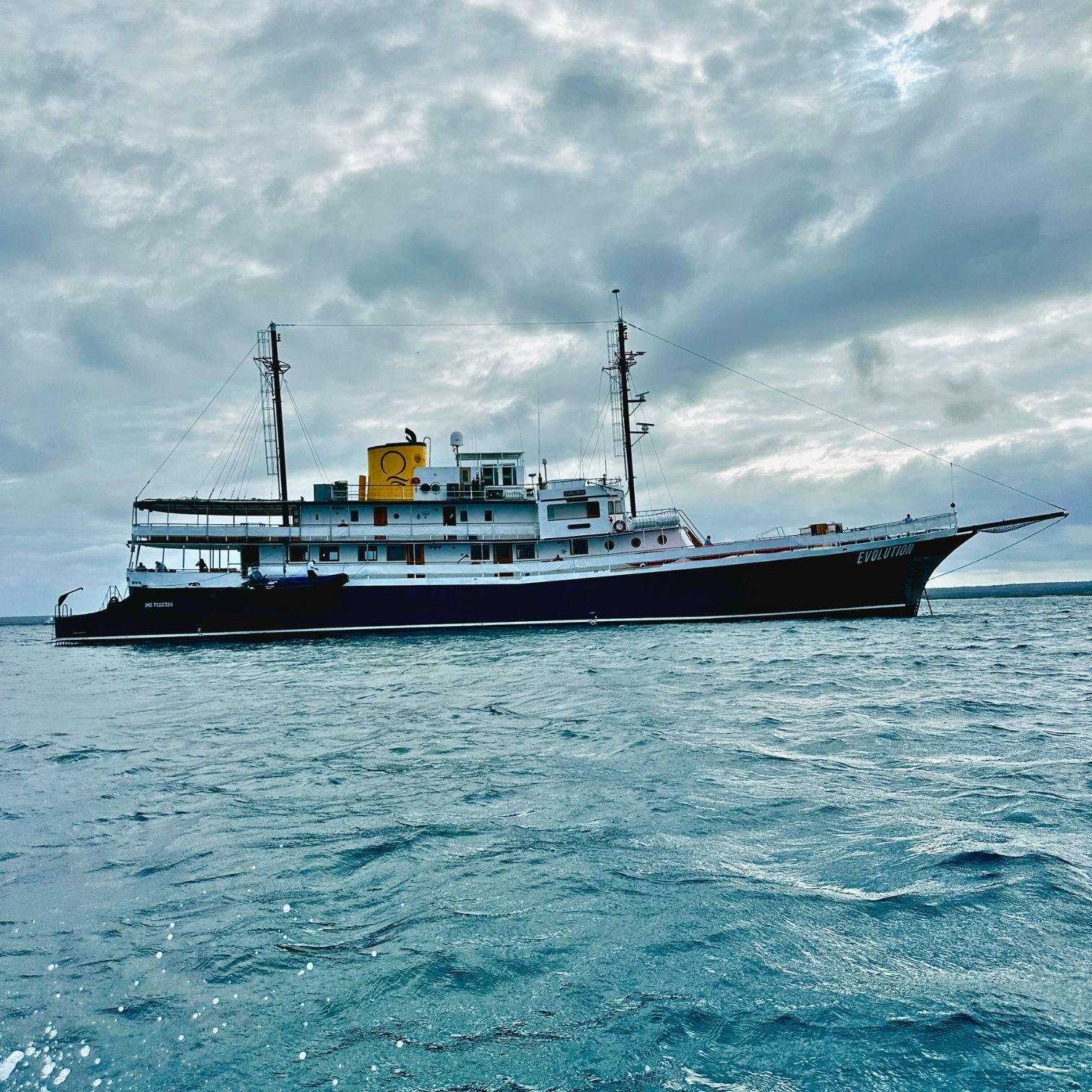
The Galápagos Aboard the Evolution
23 November–3 December 2023 · Quasar Expeditions
Ten days in the Galápagos aboard Quasar Expeditions' Evolution, a 32-guest yacht. Marine iguanas, blue-footed boobies and sea lions before we even boarded. Snorkelling with sea lions, white-tipped sharks and green turtles. Flamingos at Espumilla, giant tortoises at El Chato, and a marine iguana swimming past the panga on the final morning.
Want a voyage built around the water, not just the ship?
Tell us whether you're after warm-water snorkelling or polar diving and we'll point you to the right operator.
Request a Quote