
Responsible travel
Found, or Arranged?
Some wildlife encounters happen because you were patient. Others happen because something was put there. We think you should know which you are booking.
Glacial Expeditions prefers operators that find wildlife rather than draw it in. We will still book voyages that include baited or provisioned encounters — they are common, and in some places they are the only way to reach a species — but we tell travellers which activities involve attraction before they book rather than after. The decision stays with the traveller.
What counts as a found encounter?
A found encounter is wildlife located by a guide who knows where to look, watched at a distance the animal sets. It depends on patience, weather and luck, and nothing is guaranteed. The absence of a guarantee is the point: an animal that is free to leave is behaving normally.
Most of what we book works this way. A naturalist reads a shoreline, a captain slows the ship, and sometimes there is nothing there. The days that fail are part of the same arrangement as the days that do not.
What counts as an arranged one?
An arranged encounter is anything where food, light, sound or a structure changes an animal's behaviour so that a person can see it. Baiting, provisioning, spotlighting, chumming, playback calls and habituation feeding all belong in this category, whatever the excursion is called on the itinerary.
- Baiting — food used to bring an animal within view, then usually withdrawn
- Provisioning — regular feeding that changes where an animal spends its time
- Spotlighting — light used to find or hold a nocturnal animal
- Chumming — blood or oil in the water to concentrate predators
- Playback calls — recorded calls that pull a displaying male off his post
- Habituation feeding — animals fed until they associate people with food
Where do we draw the line?
We do not treat this as a ban. We treat it as disclosure. We will not describe a baited encounter as a wildlife sighting, and we will not put one in an itinerary without saying so. Where an operator runs an activity in a way we think is poor, we name the operator and say why.
We book these voyages. Almost every operator we work with runs at least one arranged activity somewhere in a season, and we are not holding ourselves above an industry we sell. What we can do is stop the language from doing the work — an encounter that depended on bait should not be written up as a sighting.
What does that mean in practice?
Three examples already on this site: the whale shark bagans in Cenderawasih Bay, piranha fishing in the Peruvian Amazon, and nocturnal caiman spotlighting on the same rivers. Each is arranged, each is common, and each is described on its own page as what it is.
Whale sharks at the Cenderawasih Bay bagans
Whale sharks gather at working lift-net fishing platforms because baitfish are held in the nets. We book it, and we say on the Cenderawasih Bay page that it is a provisioned encounter with a real conservation argument attached.
Piranha fishing in the Peruvian Amazon
Guides use raw meat on a hand line, and fish are released after being landed. It is on nearly every vessel's excursion list, it is optional, and the Amazon wildlife page calls it a baited activity rather than a highlight.
Nocturnal caiman spotlighting
Skiffs sweep the banks with lamps to pick up eyeshine after dark. Lighting a nocturnal animal is a disturbance; we ask how a crew runs it, we tell you it can be skipped, and we say the same on the Pacaya-Samiria page.
What about the argument on the other side?
The argument against our preference is a serious one, and we are not certain we are right. In some places provisioning gives a community an economic reason to protect a species rather than fish it. For a child, catching and releasing a piranha may be the moment a rainforest becomes real. Rehabilitation centres feed animals because that is care, not attraction.
In Cenderawasih Bay, the fishermen's tolerance of the sharks is what made a decade of satellite tagging possible, and that science supported the designation of new protected waters. A species that earns a village money is a species that village has a reason to keep. Take the tourism away and the incentive goes with it.
The case for a child is different but not weaker. Plenty of thoughtful parents judge that an hour on a hand line is what turns a rainforest from a documentary into a place their child has touched, and that a life spent caring about rivers can start there. We do not think they are being careless.
And feeding is not always attraction. A rehabilitation centre feeds manatees because the animals cannot yet feed themselves. Calling that provisioning would be a category error.
We are not setting this argument up to knock it down. It may simply be right, and in specific places we think it probably is.
What we ask of operators.
That they follow the applicable code — IAATO in Antarctica, AECO in the Arctic, national park rules elsewhere. That guides enforce distance rather than negotiate it. That any activity can be declined without forfeiting the rest of the day. And that they tell us honestly what an excursion involves when we ask.
The distance rules themselves are set out in our responsible travel guidelines, and how we assess operators over a whole season is on sustainable travel impact.
What you can ask us.
Whether a given itinerary includes any arranged encounter. How a specific operator runs it. Whether it can be skipped, and what the rest of the group does meanwhile. We answer plainly, including when the answer might cost us the booking.
A note on what this is.
We are travel advisors, not biologists, and this is a position rather than a standard. We have changed our minds about things before and expect to again. If a traveller or an operator thinks we have a case wrong, we would like to hear it.
Written by your expedition advisor
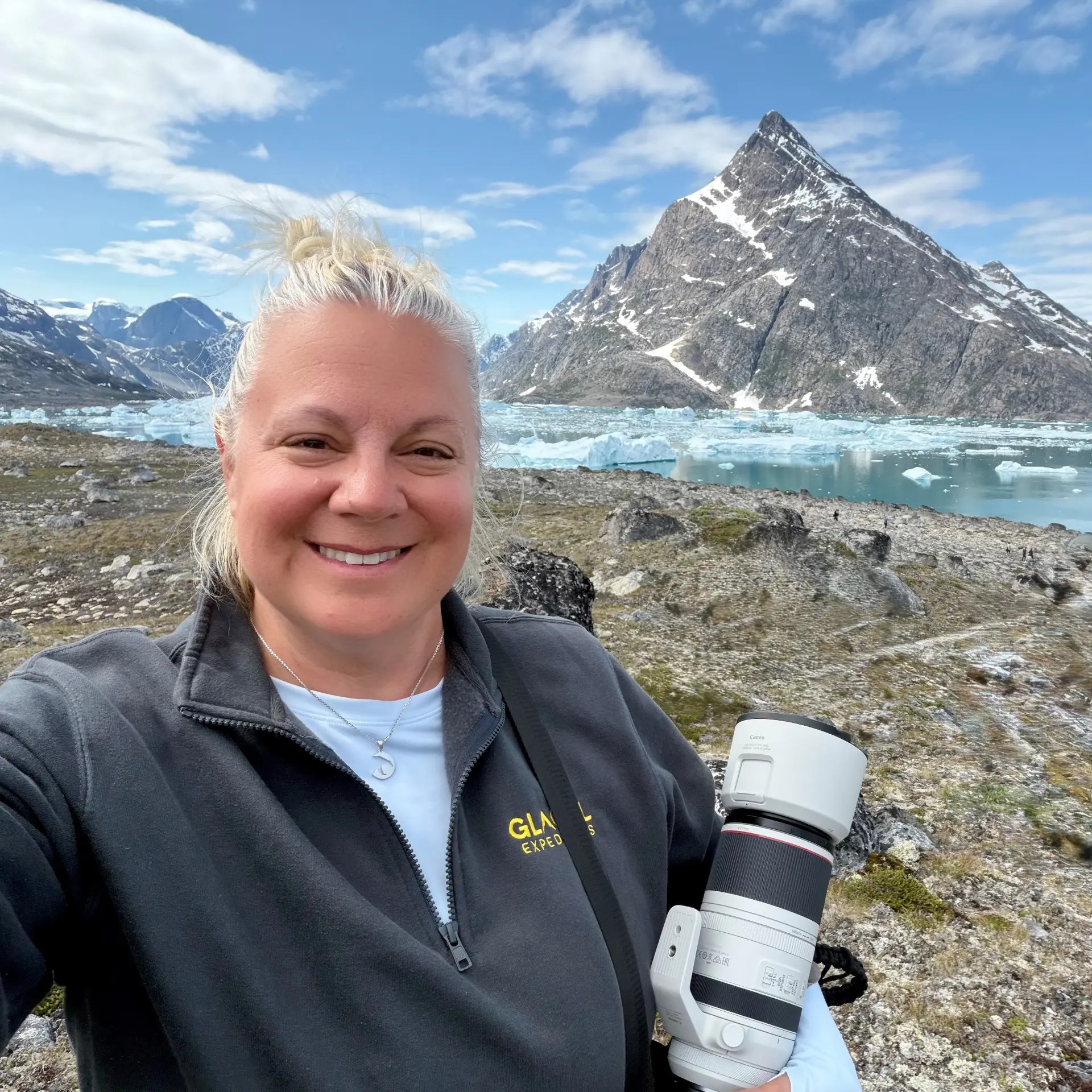
Erika Commisso · Travel Experience Architect
CLIA Elite Cruise Counselor · ASTA Verified Travel Advisor
Chris and Erika have personally sailed 18 expedition ships across eight expedition regions — and visited ten places in total, adding French Polynesia aboard the Paul Gauguin and Churchill by land.
Last updated .
Last updated 2026-09-05
Want to know what your itinerary actually involves?
Ask us before you book. We will tell you.