
Experiences
Zodiac Cruising.
No landing, no walking — just a small boat, a good driver, and whatever is close to the water that day.
A Zodiac cruise is a shore excursion that never goes ashore: small groups load into the same inflatable boats used for landings, but stay on the water for an hour or so, working close to ice faces, cliffs, waterfalls and wildlife a ship's hull can't approach. It runs alongside landings on most expedition days — sometimes instead of one, sometimes as the only outing when a landing site is closed.
What it was like for us.
In Southeast Greenland aboard the National Geographic Resolution, we lowered the Zodiacs among blue icebergs and mostly just listened — bergie seltzer, the crackle of glacial ice melting, and the boom of glaciers calving somewhere out of sight. Further south, in Skjoldungen Fjord, we cruised under waterfall faces spilling off tidewater glaciers, with hot cocoa handed round in front of a glacier front before a polar plunge into the same water.
In Antarctica aboard the Greg Mortimer, a Zodiac cruise at the Melchior Islands (dress warmer than you think) and later through Flanders Bay put us in among a great deal of ice, with kayakers and hikers sent out separately from the Zodiac groups so nobody was competing for the same water.
In the Galápagos aboard the Santa Cruz II, the local name is a panga, and a panga carried us from Baltra to the ship itself before we'd even had our first briefing — the same boat used for landings, just never touching shore that time.
In Churchill, a Zodiac cruise on the Churchill River put us close enough to watch two polar bears chase a third off a stretch of shoreline, and, on the calmer water of the Hudson Bay coast, alongside beluga mothers and calves that followed the boat and trailed in its wake.
In the Scottish Hebrides aboard HX's Spitsbergen, we took the small expedition Zodiacs to Staffa for Fingal's Cave — hexagonal basalt columns forming a chamber the ship itself could never have entered.
What's provided.
The Zodiac, a trained driver who is also a guide, and a life jacket, whatever the region. Drivers read ice and swell continuously and reposition constantly rather than holding one spot, which is how a good driver gets everyone the same view of a calving glacier or a bear on the rocks without crowding it. You bring waterproof layers and, ideally, a dry bag — spray comes over the bow more often than on a landing.
What it requires of you.
Sitting still, mostly. There's no walking involved and no fitness test, only balance to get in and out at the gangway and the tolerance to be cold and occasionally wet for an hour. It asks patience too: a driver may hold off a good angle for several minutes waiting for other Zodiacs to clear, and a cruise can be shortened or moved if wind picks up.
Which regions it works in.
Everywhere an expedition ship sails, since a Zodiac cruise is the fallback when a landing site is closed and the default alongside big ice or steep coastline. It's a fixture in Antarctica and Greenland, where tidewater glaciers and grounded icebergs are the whole point of going out; in Svalbard and Churchill for wildlife on the water; in the Galápagos, where it's called a panga ride; and in places like the Scottish Hebrides, where sea caves and stacks make a cruise more interesting than a landing.
This is the cross-region view. For what happens once a Zodiac reaches shore, see shore landings; for what the water alongside it looks like in the Arctic specifically, see Arctic kayaking.
More to read.
Related experiences: shore landings, wildlife viewing and kayaking. Back to all experiences.
Written by your expedition advisor
Chris Commisso · Expedition Expert
Signature Travel Expert
Chris and Erika have sailed ten expedition voyages and toured seven more expedition ships. Favorite explorations so far: Antarctica, Svalbard, Greenland, Iceland, Norway, Alaska, the Galápagos, the Scottish Hebrides, Churchill and French Polynesia.
Last updated .
From our journal
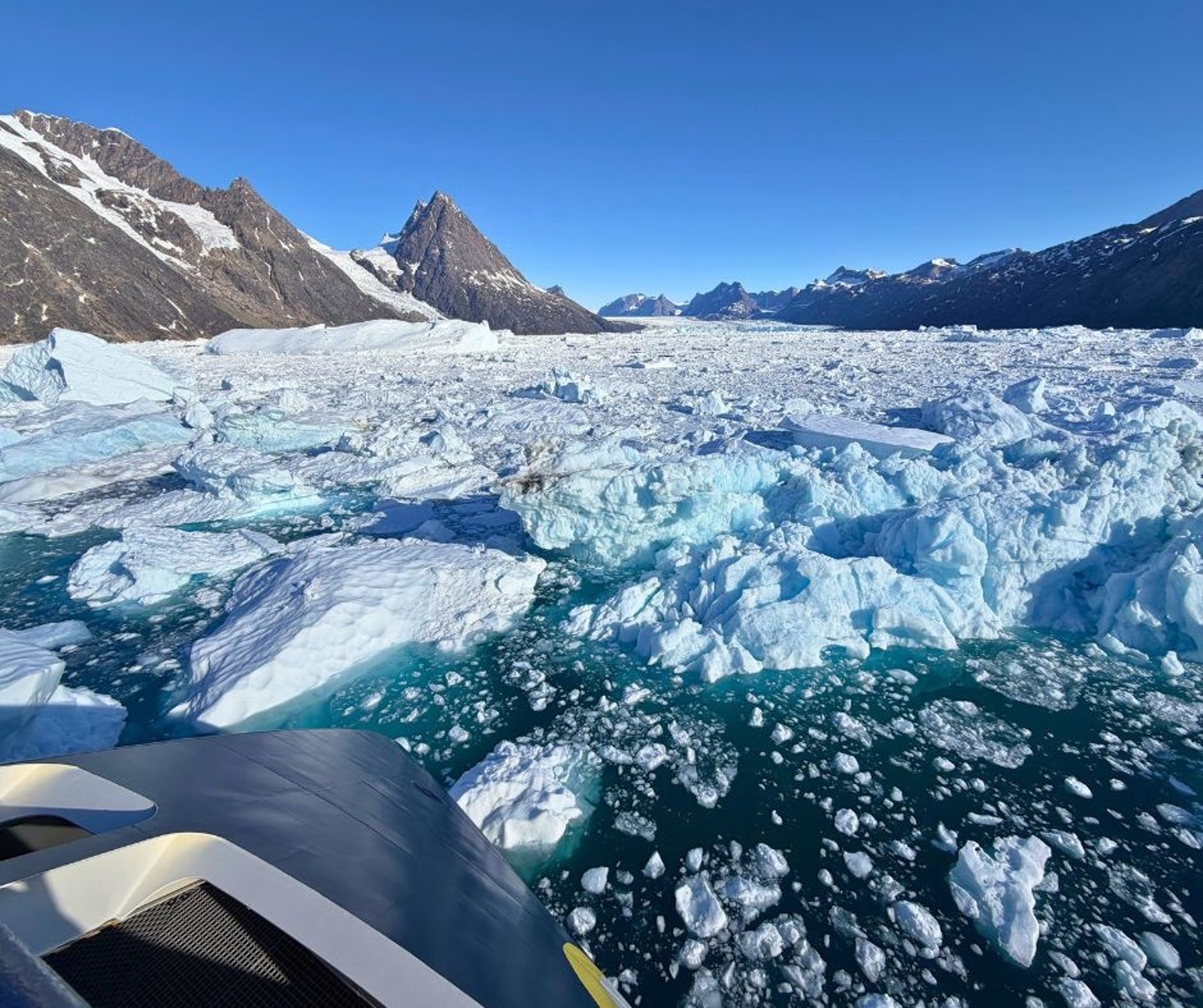
Ten Days in Southeast Greenland Aboard the National Geographic Resolution
5–14 July 2026 · Lindblad Expeditions
In July 2026 we sailed Lindblad's National Geographic Resolution round trip from Reykjavík on a new itinerary into the fjords of Southeast Greenland, some of them mapped as we sailed. We saw three polar bears, four sperm whales and about thirty pilot whales. A guest's medical emergency sent us north to Kulusuk, and gave us an unplanned day in Tasiilaq.
Want a voyage built around time on the water?
Tell us what matters and we'll factor it into which ship and itinerary we recommend.
Request a Quote