


Part of our The Arctic guide →
Svalbard's two seasons at a glance
- Midnight sun
- April to August — continuous daylight, and the only window for expedition cruises
- Polar night
- October to February — 24-hour darkness, broken only by occasional twilight hues
- Midnight sun activities
- Hiking and glacier walks, boat excursions, kayaking, wildlife safaris
- Polar night activities
- Northern lights viewing, dog sledding, snowmobile safaris, ice cave tours
- Year-round wildlife
- Polar bears, Arctic foxes and Svalbard reindeer are active in both seasons
One destination, two entirely different places
Svalbard's seasons are so extreme that the archipelago is effectively two destinations. The midnight sun (April to August) brings unending daylight and active adventure; the polar night (October to February) brings 24-hour darkness, the northern lights, and Arctic serenity. Which one is right depends entirely on your travel style.
From the unending light of the midnight sun to the eerie beauty of the polar night, each period offers its own unique adventures and encounters with wildlife. So how do you decide the best time to visit? Let's break it down.
The midnight sun: April to August
During the midnight sun, Svalbard basks in continuous daylight. The sun never sets, which creates endless opportunities for exploration without the constraints of nightfall — excursions run when the wildlife is active and the light is good, not when the clock allows.
This is the period when expedition cruises operate, and it's perfect for travelers seeking active adventures and unparalleled photo opportunities, with the glowing Arctic landscape providing a surreal backdrop.
Wildlife in the midnight sun
The light months are peak season for wildlife. The cliffs come alive with nesting seabirds — puffins, guillemots and Arctic terns — while seals and whales feed in the nutrient-rich waters. Polar bears and walruses work the coastlines and pack ice throughout the season.
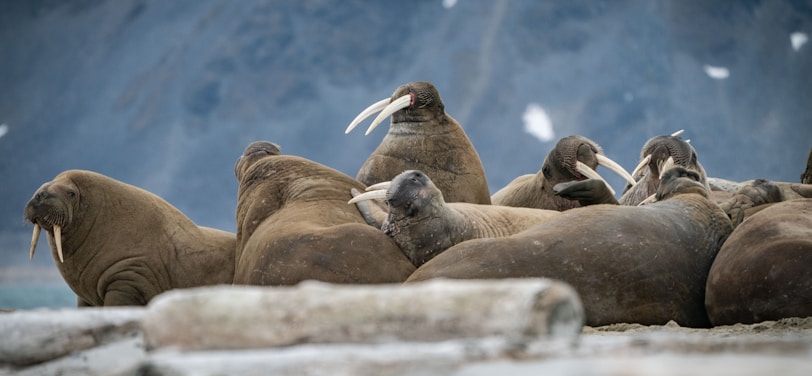
Wildlife safaris in this period can mean polar bears, walruses and Arctic foxes in their natural habitats — often in a single voyage. A hauled-out walrus group on a Svalbard beach is one of the great Zodiac moments in the Arctic; more in our Arctic wildlife guide and polar bear guide.
The polar night: October to February
The polar night envelops Svalbard in 24-hour darkness, with only the occasional twilight hues breaking the blackness. It's the season for northern lights viewing, dog sledding under moonlight and stars, snowmobile safaris to hidden ice caves and frozen waterfalls, and tours of underground ice formations carved over centuries.
This season is magical, offering a stark contrast to the vibrancy of summer. One important practical note: expedition cruises do not operate in the polar night — travel in this period is land-based, centered on Longyearbyen.
If the northern lights are the draw, our first-timer's aurora guide covers where to go, when to travel, the tracking apps worth using, and the exact camera settings that work.
Wildlife in the polar night
Wildlife doesn't disappear in the dark months — it adapts. Polar bears are active year-round and are often spotted along the icy coastlines. Arctic foxes and Svalbard reindeer both adapt to the winter's challenges, creating rare but rewarding sightings.
The polar night's surreal darkness, combined with the vivid northern lights, makes it ideal for those chasing Arctic serenity and otherworldly experiences.
Which season is right for you?
Adventurers and wildlife enthusiasts usually lean towards the midnight sun — it's the only season for an expedition cruise, with landings, Zodiac excursions and the full range of Arctic wildlife. Travelers seeking tranquility and a chance to witness the northern lights may find the polar night irresistible.
No matter which season you choose, Svalbard promises a once-in-a-lifetime journey. For the full month-by-month picture, see when to visit the Arctic; if you're still deciding between poles, our Arctic versus Antarctica comparison lays it out side by side.
Midnight sun and polar night: common questions
When is the midnight sun in Svalbard?
Roughly April to August, when the sun never sets and Svalbard has continuous daylight. This is when expedition cruises, hiking, kayaking and boat excursions operate.
When is the polar night in Svalbard?
Roughly October to February, when Svalbard sits in 24-hour darkness broken only by occasional twilight hues. This is the season for northern lights, dog sledding, snowmobile safaris and ice cave tours.
Can I take an expedition cruise during the polar night?
No. Expedition cruises operate during the midnight sun period, roughly May to September, when there is daylight and sea ice conditions permit. Polar night travel is land-based, centered on Longyearbyen.
Can I see polar bears in both seasons?
Yes. Polar bears are active year-round and are often spotted along the icy coastlines in both the midnight sun and polar night periods. Sightings are never guaranteed in either season.
Keep planning your Arctic trip
When to visit the Arctic
The full month-by-month picture across Arctic destinations.
10 fascinating facts about the Arctic
Midnight sun, polar bears, street-wandering reindeer and more.
Longyearbyen travel guide
The northernmost town in the world, and gateway to every Svalbard trip.
Kayaking in Svalbard
Paddling glacier fronts under the midnight sun.
Arctic versus Antarctica
The full side-by-side comparison of the two poles.