


Iceland aurora at a glance
- Season
- Early September to early April
- Strongest months
- October, February and March for dark plus mobility
- Limiting factor
- Cloud, not latitude
- Best base
- A car — move to the clear sky
- Not aurora season
- Late May to early August (midnight sun)
- Cruise overlap
- Iceland sailings mostly end before full darkness
Why See the Northern Lights in Iceland Rather Than the High Arctic?
Because Iceland lets you drive to clear sky. It sits under the auroral oval with a road network, guesthouses and cheap flights, so you can chase a forecast rather than wait under whatever cloud sits above a fixed lodge or a ship's position.

| Region | Season | What decides success | How you view it |
|---|---|---|---|
| Iceland | Early Sep to early Apr | Maritime cloud moving fast; you drive to clear sky | Self-drive road trip; occasional autumn sailing |
| High Arctic / Svalbard | Nov to Feb, polar night | Latitude and darkness; access and cold | Fixed base or voyage; limited mobility |
| Northern Norway | Late Sep to late Mar | Coastal cloud versus stable inland cold | Coastal voyage or inland Tromso base |
| Churchill | Jan to Mar, plus autumn | Continental cold and a high rate of clear nights | Dedicated lodge stays |
No location guarantees the aurora. Iceland's distinguishing feature is that you can move; the others trade mobility for more reliable sky.
That is the honest case for Iceland, and it is a different case from the others. Svalbard and the high Arctic offer polar night and higher latitude; northern Norway offers a long, stable, cold-and-clear season inland; Churchill offers a subarctic continental sky with very low cloud. Iceland offers mobility.
If you want the comparison rather than the repetition: northern lights in the Arctic, northern lights in Norway and northern lights in Churchill.
How Does Iceland's Weather Affect Aurora Chances?
It is the whole game. Iceland is maritime, so cloud, wind and rain move through fast and often. Latitude is rarely the problem; a low sitting over the south is. The advantage is that a front covering Reykjavik often leaves the north or east clear the same night.
This is where Iceland differs most from inland northern Norway or Churchill, where continental cold produces more consistently clear nights. In Iceland you plan around a cloud map, not a temperature.
FIRSTHAND: our April 2023 road trip showed the pattern rather than the aurora — we had four distinct weather systems in ten days, and conditions that were unusable in one region while a couple of hours' drive was clear. If we were going for the lights, we would go with a car and no fixed nightly plan.
When Is Aurora Season in Iceland?
Early September to early April, once nights are properly dark. Late September to late March is the working window. From late May to early August the midnight sun makes aurora viewing impossible, which is exactly when expedition circumnavigations sail.
Within the season there is a practical trade. October and March give darkness plus drivable roads and open accommodation. December and January give the longest nights and the worst driving. February sits in between and is our usual recommendation for a first winter trip.
Season detail across the whole year is in when to visit Iceland.
Where Should You Base Yourself in Iceland for the Aurora?
Anywhere with dark sky and an ability to move. A car with south coast, north Iceland or the east as options beats a single fixed base. Reykjavik itself is workable only as a starting point — city light and coastal cloud both work against you.
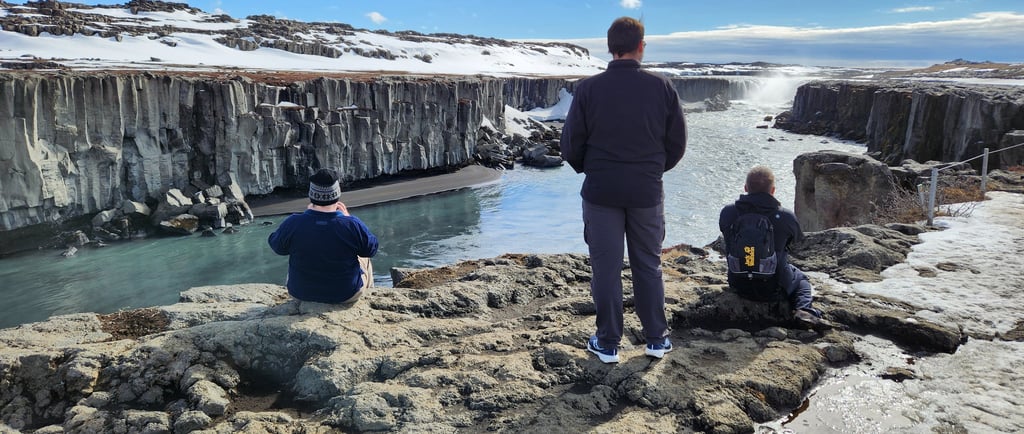
Practical bases: Vik and the Hof area on the south coast, where you can pair the aurora with glacier country; Akureyri and Lake Myvatn in the north, which often sit clear when the south is not; and the East Fjords, which are quiet and dark but a long way from Keflavik in winter.
Route ideas are in the Ring Road guide and the south coast guide.
Can You See the Northern Lights on an Iceland Cruise?
Rarely on an Iceland circumnavigation, because those sail from late May to early September under near-continuous light. Late-season September sailings and Iceland–Greenland or Norway voyages in the autumn are the realistic ship options.

A ship's advantage is a dark horizon with no streetlights and no mountain blocking the north; its disadvantage is that you cannot drive out from under a cloud bank. On land you chase; at sea you wait.
FIRSTHAND: our own Ocean Diamond circumnavigation ran 27 May to 5 June 2022, under the midnight sun — no aurora at all. That is the correct expectation for a summer Iceland voyage, and we say so rather than selling the possibility.
Sailing windows are in Iceland cruise itineraries and operators in the Iceland cruise guide.
What Do You Need to Photograph the Aurora in Iceland?
A tripod, a fast wide lens, manual focus set at infinity in daylight, and spare batteries kept warm. Start near ISO 1600 at f/2.8 for a few seconds and adjust. Phones with a night mode now manage a usable frame if braced against something solid.
Warmth matters more than kit. Standing still in Icelandic wind for an hour is colder than walking in the same temperature — see the Iceland packing list.
Iceland aurora questions
When can you see the northern lights in Iceland?
From early September to early April, with late September to late March the practical window. Midnight sun rules them out from late May to early August.
Is Iceland a good place to see the aurora?
Yes, mainly because you can drive to clear sky. Its cloud is more changeable than inland northern Norway or Churchill, but its mobility offsets that.
Can you see the northern lights from Reykjavik?
Sometimes, during strong activity, but city light works against you. Drive 20 to 30 minutes out or base yourself outside town.
Do Iceland expedition cruises see the aurora?
Usually not. Circumnavigations sail in the light months. Our own May to June 2022 voyage had continuous daylight and no aurora, which is normal.
Which month is best for the aurora in Iceland?
February and March balance dark nights with drivable roads and open guesthouses. December has the longest nights and the hardest driving.
How is Iceland different from Norway for the northern lights?
Norway's inland areas give more consistently clear cold nights and a longer stable season; Iceland gives you a road network to chase gaps in fast-moving maritime cloud.