


The comparison at a glance
- The trade-off
- Structured comfort and ease by ship versus freedom and spontaneity by road
- Cruise cost
- Roughly $5,000–$10,000 per person, largely all-inclusive
- Ring Road
- Route 1, a 1,322-kilometre loop; allow 7–10 days minimum
- Cruise advantage
- Unpack once; wake in a new harbour every day
- Road advantage
- Linger anywhere, detour freely, set your own pace
Cruise or Ring Road — what is the real trade-off?
Neither option is objectively better. Cruising is a passive, curated, stress-free way to experience Iceland's dramatic coastline from a floating hotel, ideal for travelers who value relaxation and predictability. Driving the Ring Road is an active, customizable adventure for independent travelers prepared to manage the logistics of total autonomy. The choice hinges on your priorities and how you like to engage with a destination.
We have done both — more than once — and we recommend each to different clients. What follows is the honest breakdown we work through on planning calls, before we ever talk about specific ships or itineraries.
Why is a cruise the effortless way to see Iceland?
A cruise is built on the floating-hotel concept: one comfortable base for the entire journey. You unpack once and wake in a new destination each day, with no route planning, no string of hotel bookings and no check-out times. Meals, refreshments and usually a complimentary excursion at each port fold into a single fare, and the ship moves while you sleep — so every full day goes to exploring, not driving.
Everything that makes a road trip mentally demanding — advance hotel bookings, planning food stops, watching fuel levels — is consolidated into one all-inclusive fare. You stop being a trip planner and become a guest. High-end amenities such as spas, gyms, pools and live entertainment reinforce that sense of a genuine vacation, with rest and rejuvenation a self-drive trip rarely allows.
What can you only see from the water?
Sailing the coastline reveals fjords, towering cliffs and massive glaciers that simply are not visible from the Ring Road. Cruise itineraries also reach places that demand major detours by car — Grímsey Island, where you cross the Arctic Circle, and the Látrabjarg bird cliffs, the largest in Europe — plus superb marine wildlife, from whale watching in Húsavík to puffin colonies along the coast and in the Westman Islands.

These voyages feel closer to an expedition than a traditional cruise: ships are often smaller, excursions are expert-led, and landings sometimes use small rigid inflatable boats. One honest caveat: excursions to inland attractions can mean a long bus ride each way, which cuts into the sense of exploration.
Is an Iceland cruise worth $5,000–$10,000 per person?
The upfront fare looks steep, but it buys budget predictability. All onboard meals, specialty coffees and bottled water, and usually at least one complimentary shore excursion per port are included, so the bulk of your trip is accounted for in a single payment. Optional premium excursions cost extra, but the core of the trip is financially transparent from the outset — unlike a self-drive trip, where fuel, food and lodging costs fluctuate.

The premium is not only for amenities; it is for the peace of mind of a largely fixed, all-encompassing price. For travelers who prefer to avoid a dynamic, à-la-carte budget, that certainty is a feature in itself.
What are the real limitations of cruising?
The price of convenience is flexibility. The itinerary is fixed at booking, with set arrival and departure times in every harbour — you cannot linger at a captivating spot or take an unplanned detour, so each stop is a quick taste rather than a deep exploration. Ship size can also restrict access: some vessels are too large to dock in smaller villages and must ferry passengers ashore by tender, as in the Westman Islands.
What does driving the Ring Road give you instead?
Complete ownership of your journey. You set the pace, route and stops, and you can linger at a favourite waterfall, take an unplanned hike or pull over for a photograph whenever the light turns. Long stretches pass with no sign of civilization or other cars — a rare solitude that makes the journey feel like a genuine expedition. You act as planner, navigator and problem-solver, and in exchange the trip becomes entirely your own.
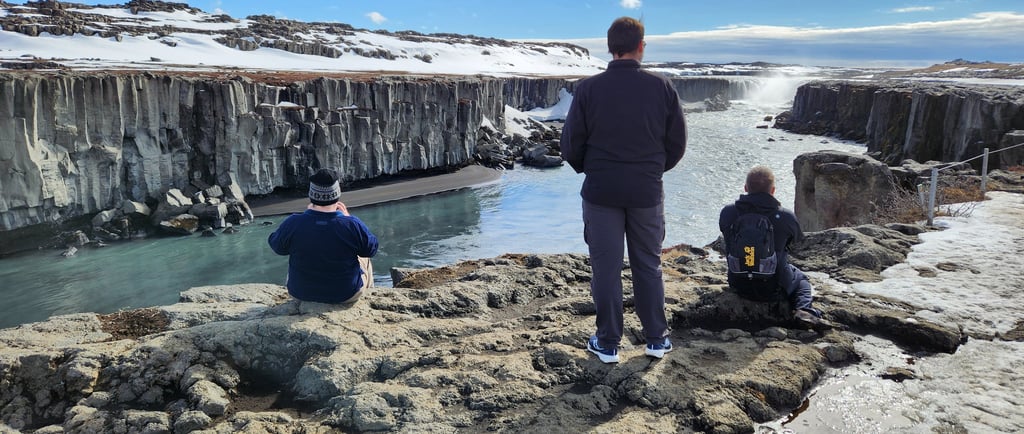
That sense of personal discovery defines the Ring Road experience. The road itself is as much the destination as the sights along it. Our ten-day Ring Road itinerary is the route we build for clients who choose the drive.
What does a Ring Road route actually look like?
Route 1 is a 1,322-kilometre loop around the entire country. It is technically drivable in about 17 hours, but 7 to 10 days is the widely recommended minimum for a comfortable pace. A typical itinerary begins and ends in Reykjavík and runs counter-clockwise: the Golden Circle (Þingvellir, Geysir, Gullfoss), the South Coast waterfalls and black sand beaches, the glacier lagoons of the southeast, the east fjords, and Lake Mývatn in the north.
How hard is the Ring Road, honestly?
The freedom is contingent on managing real challenges. Iceland's weather can shift from sunshine to a full blizzard in minutes, causing sudden road closures. Roads, though generally well maintained, feature single-lane bridges, gravel surfaces and free-roaming sheep. And in remote stretches — especially in the east — fuel, restaurants and grocery stores are sparse, so constant planning is part of the deal.
None of this is a reason not to go; it is a reason to go prepared. A well-built self-drive itinerary pre-books the stays, spaces the driving days sensibly and plans fuel and food stops before you ever turn the key — which is exactly the part we handle for clients.
So which should you choose for a first visit?
Choose the cruise if you value relaxation, predictability and seeing the coastline — including remote islands and bird cliffs — without managing logistics. Choose the Ring Road if you want spontaneity, immersion and the freedom to chase waterfalls, hot rivers and side trips on your own schedule. Many travelers do both across two trips, and they report back that the experiences barely overlap.

| Iceland by cruise | Ring Road self-drive | |
|---|---|---|
| Style | Passive, curated, stress-free | Active, hands-on adventure |
| Base | One floating hotel — unpack once | A string of hotels and guesthouses |
| Flexibility | Fixed itinerary and port times | Complete freedom to linger and detour |
| Access | Remote islands, bird cliffs, coastal fjords | Interior sights, waterfalls, hot rivers |
| Budget | ~$5,000–$10,000 pp, mostly all-inclusive | À la carte: fuel, food, lodging fluctuate |
| Wildlife | Whales from Húsavík, puffin colonies by sea | Puffin cliffs, seals, roadside Arctic fox |
| Challenges | Tender ports, bus rides to inland sights | Weather closures, single-lane bridges, sheep |
| Best for | Relaxation and predictability | Independence and immersion |
Costs reflect typical circumnavigation fares at time of writing; self-drive budgets vary widely with season and style.
If you are torn, that is exactly the conversation a 30-minute planning call is for — we have driven the loop and sailed the coast, and we will tell you plainly which one suits how you travel.
Cruise or Ring Road: common questions
Is it better to cruise Iceland or drive the Ring Road?
Neither is objectively better — they are different trips. A cruise trades flexibility for effortless comfort and access to remote coastal locations; the Ring Road trades ease for complete freedom and immersion. We have done both several times and recommend each to different travelers.
How much does an Iceland cruise cost compared to the Ring Road?
Circumnavigation cruises typically run $5,000–$10,000 per person, largely all-inclusive — meals, refreshments and usually one excursion per port. A self-drive trip is à la carte: fuel, food and lodging fluctuate with season and style, so the total is less predictable.
How long does it take to drive Iceland's Ring Road?
Route 1 is a 1,322-kilometre loop, technically drivable in about 17 hours. Allow at least 7 to 10 days to explore comfortably — our recommended itinerary runs ten days, including the Golden Circle, South Coast, glacier lagoons and Lake Mývatn.
What can you see on an Iceland cruise that you cannot see from the road?
Dramatic fjords, cliffs and glaciers visible only from the water, plus destinations that demand major detours by car: Grímsey Island on the Arctic Circle, the Látrabjarg bird cliffs — the largest in Europe — and the Westman Islands, with superb whale watching at Húsavík along the way.
Can Glacial Expeditions help me decide — and then book it?
Yes. We have explored Iceland by cruise and by Ring Road multiple times, so the advice is firsthand. Book a 30-minute call and we will match the style to how you travel, then build the itinerary — ship and cabin, or route, stays and experiences.
Keep planning your Iceland trip
Driving Iceland's Ring Road
Our day-by-day ten-day Route 1 itinerary, from Keflavík to the Snæfellsnes finale.
Iceland's South Coast
Waterfalls, black sand beaches and glacier lagoons in more detail.
Best time to visit Iceland
Daylight, weather and northern lights by month.
Iceland hot springs
From the Blue Lagoon and Sky Lagoon to wild hot rivers.
Iceland packing list
What to bring for waterfalls, hot rivers and changeable weather.
Iceland overview
The full destination guide, from regions to planning.