

Part of our The Galápagos guide →
You pay the same as booking direct. Here’s how we’re paid.
Galápagos routes at a glance
- Trip length
- 4-day snapshots through to comprehensive 8-day expeditions
- Western Route
- Young volcanic Isabela and Fernandina — marine iguanas and flightless cormorants
- Eastern Route
- Older Española and San Cristóbal — waved albatross and all three booby species
- Central & Southern
- Santa Cruz and Floreana — tortoises, Darwin Station, Post Office Bay
- Who sets the routes
- The Galápagos National Park licenses each vessel's itinerary
Why are Galápagos itineraries fixed?
The Galápagos National Park carefully regulates cruise routes so visitors see the archipelago's biodiversity while minimizing environmental impact. Itineraries are not arbitrary — they are designed to give you as much wildlife coverage as possible in each respective region.
The length of the journey dictates how many islands you visit and how many ecosystems you see. Shorter itineraries offer a taste of one region; longer voyages give a more complete narrative of the islands' geological and evolutionary history. That structure is what lets you choose a trip aligned to your interests rather than hoping the route happens to suit you.
How do the Western, Eastern and Central routes compare?
Western routes cover the geologically youngest islands and the highest concentration of marine iguanas. Eastern routes cover the older, eroded islands and the richest birdlife. Central and Southern routes combine both, adding Santa Cruz, the Charles Darwin Research Station and Floreana's human history.
| Route | Islands | Signature wildlife | Best for |
|---|---|---|---|
| Western | Fernandina, Isabela | Marine iguanas in huge numbers, flightless cormorants | Volcanic landscapes and raw geology |
| Eastern | Española, San Cristóbal | Waved albatross (Apr–Dec), all three booby species at Punta Pitt | Birdwatchers and established ecosystems |
| Central & Southern | Santa Cruz, Floreana | Highland giant tortoises, flamingos, sea turtles | A first visit balancing wildlife, conservation and history |
Every vessel sails a route licensed by the Galápagos National Park, so choosing the ship and choosing the route are the same decision.
What does the Western Route include?
Often considered the most pristine, the Western Route focuses on the geologically younger islands of Fernandina and Isabela. These volcanic islands are still forming, and they showcase an incredible adaptation of life to harsh, recently formed landscapes.
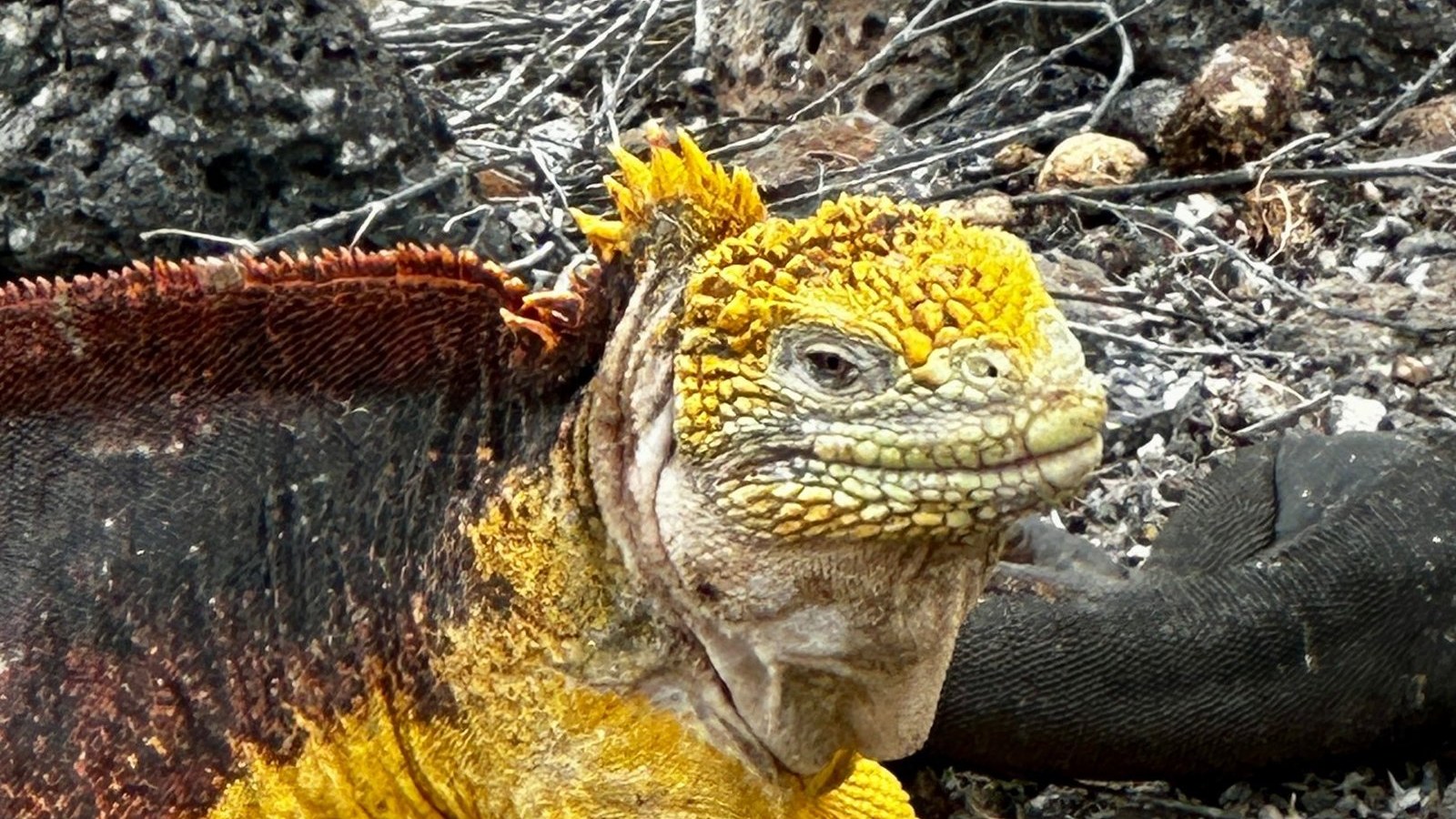
Travelers here can expect the world's highest concentration of marine iguanas and the endemic flightless cormorant. Key sites include Punta Espinoza, with its vast marine iguana colonies and cormorants, and Punta Vicente Roca, a dramatic collapsed volcano with rich marine life at its base. The geology of these islands is directly linked to the species that inhabit them — it is evolution still in progress.
What does the Eastern Route include?
The Eastern Route explores the older, more eroded islands such as Española and San Cristóbal. They have had more time to develop distinct ecosystems and are a key destination for migratory birds — a paradise for birdwatchers.
The headline event is the massive colony of waved albatrosses that arrives on Española between April and December to court and nest. Punta Pitt on San Cristóbal is a rare site: the only location in the Galápagos where all three booby species — blue-footed, red-footed and Nazca — can be seen together.
What do the Central and Southern routes include?
These itineraries combine elements of east and west for a more accessible and diverse experience, taking in iconic islands like Santa Cruz and Floreana. A visit to the Charles Darwin Research Station on Santa Cruz explains the conservation work behind the famous giant tortoise breeding program.
Travelers also see giant tortoises in their natural habitat in the humid Santa Cruz highlands. Floreana blends natural beauty with human history: Post Office Bay, where a mail barrel has been in use since the 18th century, and Cormorant Point, a sea turtle nesting site with a flamingo lagoon.
What do the landings actually look like?
Galápagos days are built from two outings — a morning and an afternoon — each one either a walk on a marked trail, a panga (zodiac) ride along a shoreline, or time in the water. The islands themselves set the character of each one.
On the Western Route, Punta Vicente Roca has no landing site at all: the visit is a panga ride beneath the collapsed wall of Ecuador Volcano, where sea turtles, penguins, flightless cormorants and Mola mola drift in the cold upwelling. Fernandina's Punta Espinoza is the opposite — a black lava landing where marine iguanas pile on top of one another in the hundreds and Sally Lightfoot crabs cover the rocks.
On the Central and Southern routes, Santa Cruz gives you the two halves of the island in a day: the Charles Darwin Research Station in Puerto Ayora, where the tortoise breeding program is explained by the people running it, and the misty highlands where wild giant tortoises graze in farm pasture. Floreana adds Post Office Bay, where you sort through the barrel for a postcard addressed near your home and hand-deliver it, and Champion Islet, a snorkel site off the coast known for sea lions, rays and one of the last populations of the Floreana mockingbird.
The Eastern Route is the birding week. Española's cliffs at Punta Suárez hold the waved albatross colony and a blowhole; Punta Pitt on San Cristóbal is the archipelago's only site where all three booby species nest side by side.
How many days do you need in the Galápagos?
Four-day trips give a snapshot of a single region. Five to six days covers one route properly. Eight days is the comprehensive option: more islands, more ecosystems, and the full arc of the archipelago's geological and evolutionary story. Longer is genuinely different, not just more.
There is a second way to get length: sailing two itineraries back to back. Because each licensed route visits a different set of islands, combining a Western week with an Eastern or Central one gives you close to the whole archipelago on a single vessel, without repeating a landing. Operators price these as combination voyages, and they are the closest thing to a complete Galápagos trip.
Galápagos itineraries: common questions
Can I design my own Galápagos itinerary?
Not on a cruise. Routes are licensed by the Galápagos National Park and fixed per vessel, so you choose the ship whose route matches your interests. Land-based trips and extensions offer more flexibility.
Which Galápagos route is best for first-time visitors?
Central and Southern routes are the most accessible and diverse, combining Santa Cruz, the Charles Darwin Research Station, highland tortoises and Floreana's history with classic wildlife sites.
Where can I see the waved albatross?
On Española, on Eastern routes, between April and December, when the colony arrives to court and nest. It is the only bird that truly migrates away from the islands.
Where can I see all three booby species together?
Punta Pitt on San Cristóbal, on the Eastern Route — the only site in the archipelago where blue-footed, red-footed and Nazca boobies can be seen together.
Can I combine two Galápagos itineraries?
Yes. Many vessels sell back-to-back voyages that pair two licensed routes, so you cover a much larger share of the archipelago without repeating a landing site.
Is a 4-day Galápagos cruise worth it?
It gives a genuine taste of one region and works well bolted onto an Ecuador trip. If the Galápagos is the reason you're traveling, a longer itinerary covers far more ecosystems.
Keep planning your Galápagos trip
When to visit the Galápagos
Warm season versus garúa season, month by month.
Galápagos ships and yachts
Small yacht or larger vessel — how the choice changes the week.
The islands
Island by island through the archipelago.
Journal: Santa Cruz II, Northern Route
What a real itinerary looked like, day by day.